Welcome to Erin's Home, where her family and friends follow her example of living with gusto every day. What verb do you choose?
Pages
Sunday, November 21, 2010
Achieve Fame
Thursday, November 18, 2010
Drive
Monday, November 15, 2010
Grade
I hope to climb out of the grading well before next weekend arrives. Right now, I'm mired in mid-term papers (41 of them. . .each 7-10 pages). Here's a hint:

If you circle all the forms of the "to be" verbs in any ten consecutive sentences of your paper, your paper shouldn't look like it has the measles. The twenty little circles pictured here far exceeds expectations.
A friend of mine named Harold taught me this rule about passive writing.
He went on to illustrate it for me so I would never forget. "Don't bore your reader," he explained, "by saying 'Mary is sick.' While perhaps true and perfectly accurate, a livelier approach uses the right action verb to catch the reader's attention and propel your essay forward. Instead write: 'Mary vomited.'"
Now you know the other reason why Let's Do It! always tries to choose the right verb as its title. Think of it as The Power of the Verb.
Friday, November 12, 2010
Change
Thursday, November 11, 2010
Feed

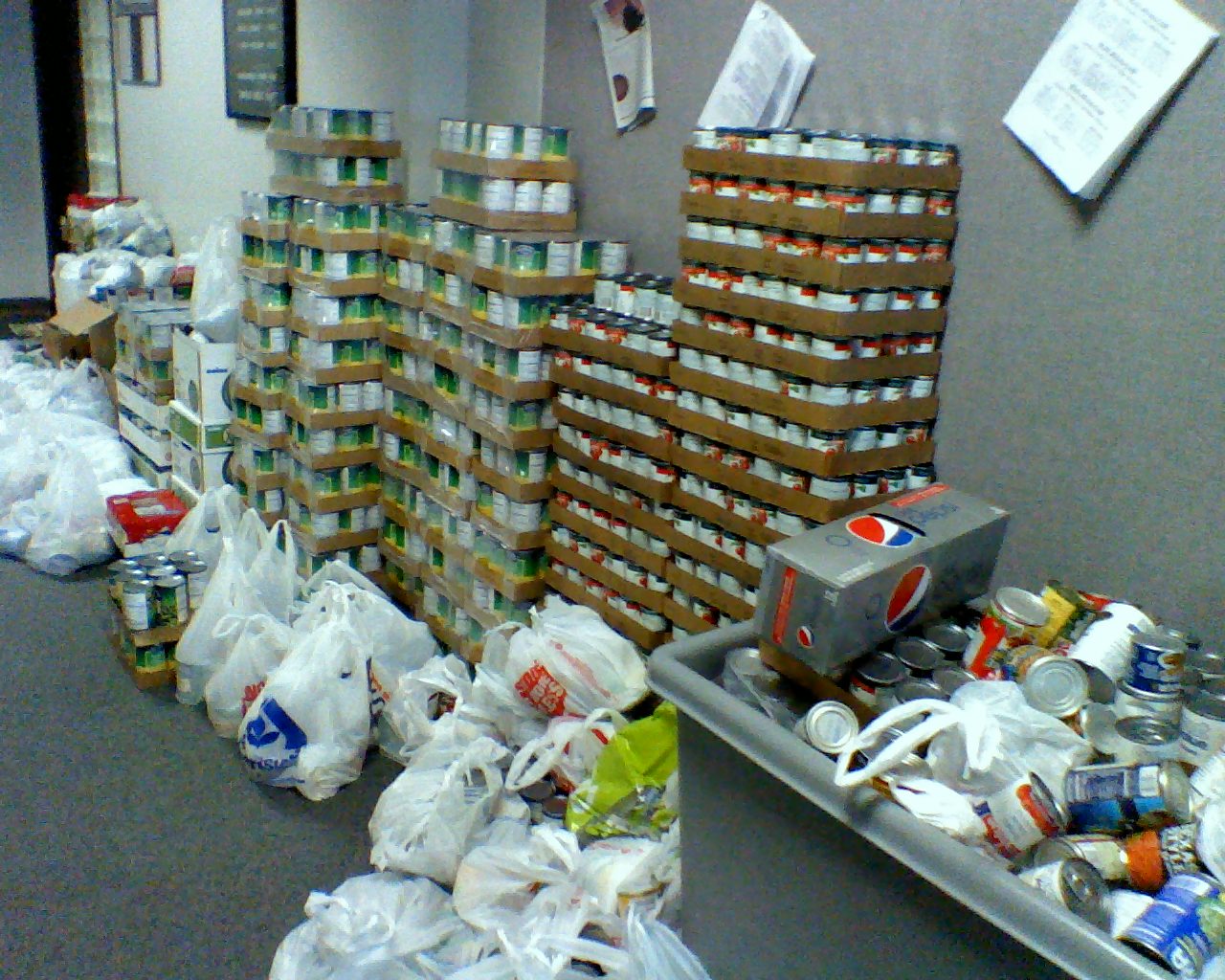
The little brown sliver to the top and far left of the photo is the door to my office suite. The food extends on the other side of that door and down the hall in the other direction. Every fall, students in MGMT 209, 211, and increasingly other courses collect food for our local food bank and its hungriest citizens.
I don't mind walking around canned corn to get into my office!
The other fall project that Keith Swim (the mastermind behind the food drive) sponsors is a toy drive for kids in Child Protective Services in Brazos County. His project actually provides gifts to more than 20% of the 500+ CPS children in the area. He tries to make sure that each child receives three gifts. You do the math.
Because I think Keith is such a fantastic guy and this is such a worthwhile project, I wanted to share his appeal with you:
It is that time of the year again for our annual toy drive for children at Child Protective Services. For those of you who do not know what I am talking about, my students (MGMT 211 and MGMT 209) have for several years agreed to sign up to purchase toys and clothes for the children under the care of Child Protective Services. These are children in the Brazos Valley who have been taken away from their parents due to physical, sexual or emotion abuse and placed into foster care. The children are allowed to pick three (3) toys/gifts that they would like to have for Christmas and also provide their clothes and shoes sizes. My students then sign up for a toy/gift or clothes to purchase for the child. They also solicit help from their Student Organization, the Corps, Fraternities, Sororities, churches, etc. Several students’ families will take an entire child to adopt.
We have committed to purchase Toys/Clothes for 110 children this year and would like to do even more. (CPSC has about 500 children that they need people to “adopt” during the holiday season.
So where do you come in?
Some of you have supported this Holiday Toy Drive for several years and we need your support again. So, if you are interested, here is how you can help:
1. You can contact me and pick up the list for an entire child, purchase the items selected by the child, wrap them and bring them back to me with the child’s name on the packages.
2. You can sign up for one present or clothing item, wrap the gift and return it to me with the item and child’s name on the package. (I will take the item information off, that is just so that I know if the child has received the things on his/her list.
3. You can purchase a gift card at Wal-Mart, Target, Toys R Us or Best Buy.
4. You can donate money. I don’t take money from my students but there are always items that they cannot afford to purchase so I send students out with donations and gift cards to buy items for children that didn’t get the items they had asked to receive. I am very careful which students I send to shop and I always make them bring receipts that we both go over to be sure that all of the money is spent on the children. Any amount would help.
You can drop the money or gift cards off at my office in Wehner 410 or to Phyllis in the Management Department main office Wehner 420.
If you want to see the list come by my office during my office hours:
MW 3:45 to 6 pm
TR 8-9:15 and 12:45 to 2
You can always call me at 845-3905 and I will come pick up any donations or bring the list for you to see.
Anything that you can do to help will be greatly appreciated. Thank you in advance.
Keith's email is: kswim@mays.tamu.edu
If you want to support this project you can send a check to
Keith Swim
MS 4221
Texas A&M University
College Station, TX 77843
or to me
4138 Cypress Road
Bryan, TX 77807]
And you can click here to join the facebook group for this project.
You may remember that Erin was an ancillary beneficiary of Keith's generosity during her first stem cell transplant. The students did an add-on to their collection and brought stuffed animals to the hospital to cheer her up (notice Rosie dressed in her Christmas outfit on the lower left of the animal pyramid, welcoming the newcomers to the hospital):
You can read the retrospective here. Thank you!
Monday, November 8, 2010
Light
I appreciated the extra hour of sleep on Saturday night (which actually allowed me to finish my Sunday school lesson before breakfast. . .and on a side note, allowed Walter to get even more than that done, since he didn't fall back. Instead, he ginned around doing chores wondering why he had such a layabout slacker for a wife.), but I'm not that gung ho about the change. My problemo? It is now getting light when I walk the Willie and the Teddy. Light = bad behavior. I'm not sure what it has to do with, because I'm pretty sure they both see well in the pre-dawn light (certainly much better than me) and certainly their smellers work just fine light or dark.
I won't go into the naughty details, but I will say that the ranch behind the dam brought back its emus for an encore performance (I know this because Willie sussed them out Sunday morning. I don't know how long they have been back, but they can run as fast as ever.). I can also identify a squirrel tail if it ends up on my living room carpet (thank you, Teddy. Also, NOTE BENE: The Squirrel Tails is not as good a name for a rock band as Possum's Blood.). I can only think, what will days 3, 4, 5 and so on bring?
I think the dark/light dichotomy wasn't so much that they couldn't see or smell to get into trouble, but they felt a stronger duty to protect me when I walked my weak, slow, mostly hairless self around the lake in the dark. They wouldn't stray as far from my side when they knew at any moment, I might get myself into something that I couldn't get out of (who knows what dangerous wild animals lurked behind the next tree or hidden by the next yaupon bush?).
Case in point, just a little over a week ago (BTC: Before the Time Change) as I rounded the last bend in the road and headed towards the house, I found myself in the midst of a great and almost dangerous adventure. I glanced across the fence (in Texas it's a bob-war fence, but I think you might recognize it as barbed wire) and thought I saw a flickering light about the size of a paper towel roll on my neighbor's back porch. I fumbled my glasses onto my face (since it's dark and I can't see anyway, I usually let them dangle on their chain around my neck) to check it out.
I thought to myself as I walked along,
Suspicious Self: "People didn't usually have fire on their back porch."
Rational Self: "It's probably one of those bug zappers or something with a yellow light bulb"
Suspicious Self: "Except it's flickering."
Rational Self: "The bulb is probably about to burn out."
Suspicious Self: "The size and height isn't quite right."
Rational Self: "Maybe it's a jack-o-lantern or some other Halloween decoration."
Suspicious Self: "Maaaybe, but on the back porch where nobody ever goes?"
Rational Self: "Okay, so maybe it's one of those warming pit things."
Suspicious Self: "At 6:00 in the morning? When it is already in the mid 70s?"
I walked the dogs back to the closest vantage point and tried to figure it out. I decided to take the dogs home and come back with my binoculars and look (I know, you really don't want to move to my neighborhood now that I have confessed to stalking my neighbor's homes in the early hours with binocs).
Within the couple of minutes it took to get the dogs home, retrieve the field glasses (and my cell), and make it back to the fence line, the paper-towel sized flame had more than tripled in height, and my Rational Self had no other response than to phone Walter to call 911 and hump myself over the fence to see if anyone but me had noticed that the back porch was definitely on fire.
By the time I reached the house, the five people who lived there were making their way outside--no injuries, but quite a lot of agitation, especially from the three teens, who were really confused (one wanted to rush back in for his library books, another announced she wasn't going to school until at least second period). I took the teens out to the main road to wait for the fire truck (so they wouldn't keep trying to rush back into the smoke for their phone chargers) and let the adults move the family car away from the flames.
The professionals arrived to take care of everything, and I crossed back through the field and over the fence to my waiting coffee and those vigilant pups who were almost apoplectic that I was out before light without them to protect me.
Thursday, November 4, 2010
Hope

- standing in front of the very angry tea-party led crowd a the Health Care Town Hall in August 2009 when I introduced Chet;
- speaking on Chet's behalf at Candidate's forums from Millican and Wellborn into north Bryan at the Hispanic Forum's meeting at the Sons of Herman Hall;
- planning and organizing 14 house parties--13 in August. . .2 in my own home;
- hanging around with twenty-somethings who live on Red Bull, Layne's chicken strips, and candy for weeks at a time;
- working every day in an office that didn't have a single comfortable or posture-supporting chair;
- driving t-posts in the Brazos clay that hadn't seen rain in way too long;
- staring at my facebook friends list to see if I could impose on any of them ONE MORE TIME to do something for the campaign;
- playing the game Stump Vickie, which involved staff or interns requesting something they wanted or needed, betting that I didn't have it in my car or home. I almost always won this one!
- building a database called Hard Democrats Vickie Knows and wishing it were longer;
- providing first aid for burns to a staffer who put out a flaming shirt by stamping on it with his (bare) foot and for a dog bite to a cavasser (from the gear in my car--this included betadine, hydrogen peroxide, cotton balls, gauze pads, neosporin, blister pads, and bandages).
- phoning across the district--not just the supporters and undecideds--but also those who used quite lively and unfriendly invectives before hanging up;
- block walking in the cold, dark, and rain in an unfamiliar neighborhood alone until the polls closed on Tuesday;
- I could go on, but you get the drift.
Here's one reason I remain hopeful:
This is Beatrice Grear. She told me to call her BeBe (which, coincidentally, is what Erin preferred me to call her). She's 86 and has voted in every election that she has been eligible to vote in. She thought she would miss this year because she had to sell her car and has a hard time getting around. I drove her to early vote. We did it curbside so she wouldn't have to negotiate the ramp up into Galilee Baptist Church.When we got there the election judge didn't hassle her for having no registration card nor a driver's license. BeBe reached into her purse and pulled out a fat bundle of mail wrapped in rubber bands, which she handed to the judge. The judge found her tax bill, had her sign it, and certified her eligibility. I didn't know you could vote without a picture ID, but it is the law!
When they brought the machine to my car and set it on her lap, BeBe had a quick trigger and hit select before she had instructions. Her choice lit up: Straight Ticket (Party X). The election judge stopped her before she went on and carefully showed her how the machine worked. She rotated the wheel for her to demonstrate voting straight ticket and for each candidate, one at a time. Then she worked with BeBe to guarantee that she selected what she actually wanted: Straight Ticket (Party Y).
After she cast her vote, the election judge looked at me and said "I may be a lifelong member of Party X, but I always want voters to cast their vote exactly the way they want, not the way I want it."
BeBe, by the way, thanked me for taking her to vote so many times, that I was slightly embarrassed that such a simple act could elicit such appreciation.
The week before election day my friend, Erin Fry (she and Erin loved seeing each other and saying "Hi, Erin" "Hi, Erin" and giving each other knowing smiles), sent me an essay that her son, Dustin, wrote for his AP English III class, called "Hope Changes Everything." In the spirit of hope, I have included the essay in its entirety here (and added my own emphasis in bold):
Hope Changes Everything
Quantifying a feeling is strikingly difficult. Before writing this essay, I believed that I had a solid emotional understanding of what hope is, and I was surprised to find how difficult it is to put the true meaning of hope into words. To help me do so, I decided to read an online essay about hope. I found one that maintains that hope is a counterproductive force, because it results in idle wishing rather than decisive action. Reacting to that pessimistic document helped me to focus my thoughts for this essay, because I disagreed thoroughly with it. Hope, despite the dictionary definition meaning "expectation and desire," is not about wishing. Rather, hope is a trust in humanity; a faith that even when everything else fails, the "better side" of human nature will prevail--if people never stop working for what they believe in.
Disturbingly, the word "hope" is constantly abused. My peers say that they hope the next test is easy; sports fans say that they hope that the next season will be more successful. Some people use the word more sparingly, contending that one "wishes" for a good grade and "hopes" for world peace. This is a useless distinction, because it applies itself to the same, incorrect definition. Hope is not a wish for the future, but a trust that there is enough good in the world to make it a better place.
To clarify this definition, consider a man who, on his way to work, drives past a factory. Every day, he shudders at the thick, black smoke that the hulking structure exhales. Largely because of his experience with the factory, the man hopes that someday, Americans will have more respect for the environment. However, the man's feeling is not hope at all; it is merely an idle wish. The man in the example does nothing to change attitudes about the environment; he seems to wish they will miraculously change on their own. His disgust with the factory does not spur him to action. A wish is an excuse to do nothing: why should the man buy in a hybrid car or a weird-looking lightbulb when his wish for the future is a greater investment in the environment than the factory's smokestack? Unlike a wish, hope would make the man a supporter of the environment in more than philosophy. If he truly hoped that others' attitudes about the environment would change, he would trust that they would evolve if he helped them along. Unlike a wish, hope is not an excuse for inaction, but an incentive for industry.
Hope has real-life consequences. During World War II, Nazi Germany persecuted and killed millions of Jews. It was a time of terror for European Jews, and many went into hiding. This poem was found scrawled on a German cellar wall where Jews had hidden:
"I believe in the sun
even when it is not shining.
I believe in love
even when I don't feel it.
I believe in God
even when there is silence" ("Aftermath").
This poem is an example of hope. Rather than submitting to the pressure imposed by the inhumanity of the Nazis, the author of the poem remained optimistic. Even though the sun wasn't shining on the Jewish people at the time, the author of the poem knew that it would return someday. They maintained this trust even in the face of horrendous adversity. Rather than asking God to show himself, or begging the metaphorical sun to rise, the poem's author knew that God was still present, and knew that the sun would light up the world again someday. The poem's author had tremendous hope because they trusted in humanity's ability to heal, rather than quietly wishing that someday the world would be a better place.
The poem shows that hope can keep people optimistic in terrible situations. Hope can also lead to dramatic changes in the world. In pre-civil war America, millions of African-Americans were enslaved. Even those that were free faced extreme discrimination. There was crushing social pressure for them to keep their heads down and be inconspicuous. Despite this, the African-Americans invented a new culture, one that was a mixture of their home cultures and their masters'. This new culture has had a profound influence on modern-day popular culture, most famously in our music (Kennedy, Cohen, and Bailey 75). This cultural innovation exemplifies hope, because rather than submitting to the constant psychological assaults of racist white people, the African-Americans trusted themselves to survive centuries of abuse. They had faith in their own humanity, and that trust reified itself in a new culture.
A few years ago, a little girl named Erin Buenger went to my church. She abounded with energy and usually displayed a huge smile on her face. She was a near-constant presence at church, and everybody there knew and loved her. Although I never watched her play, she was apparently a great soccer player as well. It would have been impossible to guess that she suffered from neuroblastoma, a form of cancer that claimed her life at age eleven. The disease never seemed to slow her down--she worked indefatigably to raise awareness and money for neuroblastoma research. She even made friends with Congressman Chet Edwards, who worked hard to help with Erin's awareness project. Erin is gone now, but her dream remains, because of the hope of her mother. Today, Ms. Buenger runs Erin's Dream Lanyards to raise support for children's neuroblastoma. Her belief that her continuation of Erin's life work will make a difference to children with neuroblastoma is a powerful source of hope for her. This hope has enabled her to remain a positive person, despite the death of her daughter.
Though pragmatists and pessimists may rant about its uselessness, hope has an immeasurably powerful influence on the world. Hope enables people to continue living when it might seem that they have nothing else left to live for. Hope demands action when there is no other evidence that an accomplishment will be made. Hope is not an excuse, but a dare. Hope is not a cry in the darkness, but a trust in the light. Hope is the spark that makes us the human race, and not just a tribe of primates. As long as people can wake up in the morning and feel a personal connection with the rising sun, hope will live on.
Works Cited
"Aftermath and Jewish Responses to the Holocaust." Oracle ThinkQuest Libraryhttp://library.thinkquest.org/12307/aftermath.html>.
Kennedy, David M., Lizabeth Cohen, and Thomas Andrew Bailey. The American Pageant: a History of the Republic. Boston: Houghton Mifflin, 2002. Print.
Tuesday, October 26, 2010
Vote
As if you weren't already sick of reading Let's Do It! and finding links to campaign ads, early voting schedules, and reasons to vote for Chet Edwards, along I come with even more political-y stuff.
That's right, Davis had to get in on the act. Here is his letter to the Ohio State University school newspaper, The Lantern, that appeared on Sunday, admonishing his fellow students to vote:
The Nov. 2 election is just two weeks away and each of us has a choice. We can either vote or stay home, but with either choice we send a message. Voting expresses your opinion and shows interest in your future. Not voting, however, is tantamount to saying you don't care, that either choice is as good as the other. If common every day citizens don't demonstrate interest through voting, we run the risk of extremists or flawed candidates winning the day. Without voting, we leave it to others to make important decisions.
Congress passed many bills last session (including the TARP, the stimulus, Cash for Clunkers, the Health Care bill, and Cap and Trade) that will greatly affect our lives. TARP and the stimulus both hugely impacted the economic climate and could have saved us from a second great depression (we will never know how bad it could have been), but each came with a large price tag that will need to be paid down eventually. Cash for Clunkers allowed thousands of people to upgrade their automobiles, making the American roads safer and more fuel-efficient. The Health Care bill and Cap and Trade could drastically change each of their respected industries. These issues matter and will change our lives.
We are not without choice though. On the issues presented in this election, a clear distinction between the two parties exists. Real choice is before us. With our vote, we express whether Democratic policies like the Health Care bill should continue and whether Cap and Trade should be instituted. With our vote, we can indicate our preference between the cutting the budget or cutting education. We can stand up and make a choice or we can sit on the sidelines and accept whichever outcome happens. As for me, I don't want to be a bench warmer. I choose to play the game.
Frankly, we are in the game (as Davis puts it) because we care. We care more than we ever have before because Erin made us care. She was an all-in player. She would never understand why people wouldn't take the time to vote, to talk about issues, to call their Congressman, to be involved. She loved going with me to the polls, visiting with the election workers, and dreaming of when she would get to vote.
I sat at the congressional debate between Chet Edwards and his challenger last night and missed Erin. She and I had gone to every other debate Chet has had locally.
I missed her muttering "liar, liar pants on fire" when his opponent said something she thought wasn't true.
I missed her tallying up the number of times his opponent said "Pelosi" or "Obama" on her own personal scorecard (40 times, for the record) and whispering to me, "If Mr. Flores wanted to run against Speaker Pelosi why didn't he move to San Francisco instead of Bryan?"
I missed her pointing out the subtle change in Chet's expression (little more than a small nostril flare, quick parting of his lips, and a little steeling of his eyes) when something his opponent mentioned made him mad enough to provoke a hard response. When she saw that look, she would always nudge me and whisper, "here it comes" and boom, here it would come, raining down like fire.
I'm not going to tell you who to vote for (as if you didn't know already), but I will say, if you are thinking of sitting this one out, DON'T!
Vote for Erin's sake.
Sunday, October 24, 2010
Love
![]() |
| From WELCOME TO ERIN'S HOME |
| From Mo Ranch Slideshow |
| From Mo Ranch Slideshow |
| From Mo Ranch Slideshow |
Saturday, October 23, 2010
Friday, October 22, 2010
Write
October 22, 2010
Here is Walter's letter to the editor in The Eagle this morning:
A good man who has done a fine job
Chet Edwards deserves the vote of every citizen of the 17th Congressional District - not because of how he did or did not vote on the high-profile issues that received so much play in the media, but for the multitude of steps he has taken on behalf of all of us in the district.
Here are just three examples.
* He secured funding for 12 new, efficient, clean-fuel buses to replace an aging fleet and improve the mobility of those dependent on public transportation to get to work.
* He supported an increase in Pell Grants so that less well-off students can afford to attend places like Texas A&M.
* He helped pass the Conquer Childhood Cancer Act so that fewer children have to die long before their time.
These may be small things to some. Yet they make up 90 percent of what a representative does, and they vastly improve the lives and provide greater opportunity for success, prosperity, and good health for all of us.
Contrast Chet with his opponent, Bill Flores, a Houston millionaire who came to our district to buy a trophy seat in Congress, who will tell any lie and stoke any irrational fear to satisfy his latest whimsy.
Ask the many who have met him and they will agree, Chet is a good man who has done a fine job serving his district. He identifies with those with everyday problems, and he has earned our vote.
Monday, October 18, 2010
Slip Away
Arena Hall on Tabor Road
Brazos County Administration Building
College Station Utilities Meeting and Training Facility
Galilee Baptist Church
MSC, Room 146
Oct. 18 - 22 (Monday - Friday)
8:00 AM - 5:00 PM
Oct. 23 (Saturday)
8:00 AM - 8:00 PM
Oct. 24 (Sunday)
10:00 AM - 3:00 PM
Oct. 25 - 29 (Monday - Friday)
8:00 AM - 8:00 PM
Saturday, October 16, 2010
Invite


Thursday, October 14, 2010
Match or Not
Sunday, October 10, 2010
Laugh and Appreciate