Pages

Wednesday, September 26, 2012

Too Important!

September 26, 2012

I fully well know that I owe you a post with all the news of the recovering Philip the Handsome and the even lengthier news of the visit from the Tjoelkers, and when I turn back the set of papers I'm working on that have a hard-stop deadline tomorrow morning, I will fill you in.  In the meantime, I have blatantly, but I think with blessings, stolen this post from my friend Bob at PAC2.

I am well aware that I am asking you to read about childhood cancer statistics, but if it weren't INCREDIBLY important, I wouldn't ask you to do it.  If you need any incentive, here's the punchline that's at the bottom:

The world tends to grab hold of the much publicized statistic that we "cure" 80 % of kids diagnosed with cancer (that dark red slice of the pie).  That statistic might be true in the literal sense, but you all know that Erin always counted as one of the 80% because she live more than five years after her initial diagnosis.  Don't look away and don't skip this entry because if has both hard truths and arithmetic.  Read all the way to the bottom and decide what needs to happen.  

 I'm thinking we need to turn the circle green.


Childhood Cancer - Current Long-Term Outcomes

Dear PAC2,
Childhood cancer statistics can be confusing. Any statistics can hide or distort the truth, and even the statistics we trust may only tell part of the story.
This article delves into some familiar childhood cancer statistics and attempts to determine the projected lifelong outcomes for a child diagnosed with childhood cancer in the United States today. By lifelong outcomes, we mean what may happen over that child’s entire life--not just today or in five years, but 10, 20 or 30 years from now (which is as far as the data will let us project).

Why do this?
Children have their whole lives ahead of them, so life-long outcomes carry more weight and meaning than the commonly tracked and quoted “80%” that only represents the subgroup of children who live for 5-years after diagnosis. Children who die as a result of their cancer beyond the 5-year milestone or who experience the impact of chronic health conditions caused by their cancer treatments are not considered in the "80%".
But we all want to plan for our child’s future. College. Marriage. Having kids of their own. We need to ensure our children live to 70, 90, 110! We can’t just be satisfied that a child diagnosed at age 2 lives to age 7!  Our goal can ONLY be that any child diagnosed with cancer lives a normal lifespan not struck short by premature death from being “cured” or hampered by chronic health conditions.
This article will estimate the likelihood of these four outcomes for a child diagnosed with cancer:
Outcome #1 - A child lives at least 30 years after diagnosis without chronic health conditions
Outcome #2 - A child lives at least 30 years but faces mild to moderate chronic health conditions
Outcome #3 - A child lives at least 30 years but faces life-threatening or disabling chronic health conditions
Outcome #4 - A child dies

Data Set for Childhood Cancer - Current Outcomes
This section will identify the key statistics used in the analysis and the source of the statistics. The first data set is provided by the Children's Oncology Group. The remaining data come from the Childhood Cancer Survivor Study (CCSS). The CCSS is the largest, nationwide project to track and evaluate the outcomes for childhood cancer survivors. About the CCSS: “The CCSS is a component of the Long Term Follow Up Study, began in 1994 and is a collaborative, multi-institutional study funded by a grant from the National Cancer Institute of the National Institutes of Health and funds from ALSAC, St. Jude fundraising organization. The CCSS is composed of individuals who survived five or more years after diagnosis for cancer, leukemia, tumor, or similar illness diagnosed during childhood or adolescence. The CCSS, which includes all participants in the Long Term Follow Up Study with a confirmed diagnosis of cancer, is a retrospectively ascertained cohort of 20,346 childhood cancer survivors diagnosed between 1970 and 1986. It also includes approximately 4,000 siblings of survivors who serve as the comparison group for the study.”
Data Set #1 – Number of diagnosis and the average 5-year childhood cancer survival rate
The first set of data is provided by the Children’s Oncology Group (COG). The data includes the number of children under age 20 diagnosed annually in the US (13,500) and the percentage of those children that will survive at least 5 years (80%). Note that 80% is not representative of any specific type of childhood cancer; but instead represents the average result for 100% of the children diagnosed every year in the US. The data can be viewed here: Childhood Cancer Facts and Statistics.
Data Set #2 – Number of children that suffer chronic health condition
The second data set is from Chronic Health Conditions in Adult Survivors of Childhood Cancer: The Childhood Cancer Survivor Study (N Engl J Med 2006; 355:1572-1582 October 12, 2006)
The study reviewed the health status of 10,397 adults who received a childhood cancer diagnosis between 1970 and 1986. The survivors range in age from 18 to 48, with an average age of 27 years old. The time from the initial diagnosis to participation in the study ranged from 6 to 31 years and averaged 18 years. The study compared the health status of the survivors to that of siblings.
The primary cancer diagnosis for the study participants included; leukemia (30%), Hodgkin’s disease (18%),central nervous system tumor (13%), bone tumors (11%), sarcoma (10%), non-Hodgkin’s lymphoma (9%), Wilm’s tumor (7%), and neuroblastoma (4%). Treatments included chemotherapy (67%), radiation (62%), unknown treatment (15%) and no treatment (6%).
Survivors reported chronic health conditions including; vision, hearing and/or speech problems, infertility, psycho-social issues, cardiovascular, pulmonary, gastrointestinal, renal, musculoskeletal, neurological, and/or endocrine conditions, and/or secondary cancers.
Conditions were assigned a Grade, or severity level, relating to specific conditions, as shown below:
Grade One - Mild (night blindness, hearing loss, hypertension, shortness of breath, kidney stones, diabetes)
Grade Two - Moderate (cataracts, cardiomyopathy, hepatitis, seizure disorders)
Grade Three - Severe (blind, deaf, emphysema, major joint replacement/amputation, infertility)
Grade Four - Life-threatening or disabling (heart transplant, cardiac arrest, paralysis, respiratory arrest, kidney transplant, cognitive deficit)
Grade Five - Death
It should be noted that for deceased survivors, the maximum Grade condition reported before death was used.
Key conclusions from the report include:
  1. Survivors of childhood cancer have a high rate of illness owing to chronic health conditions.
  2. Among survivors, the cumulative incidence of a chronic health condition reached 73.4% 30 years after the cancer diagnosis.
  3. Among survivors, the cumulative incidence for severe, disabling, or life-threatening conditions or death due to a chronic condition is 42.4% 30 years after cancer diagnosis.
  4. Thus, by subtraction, the cumulative incidence of mild to moderate conditions 30 years after diagnosis is 31% (73.4%-42.4%).
To read more on chronic health conditions of childhood cancer survivors visit the PAC2 Library.

Data Set #3 – Number of Children that die after surviving five years
The third data set is also from the CCSS: Cause-Specific Late Mortality Among 5-Year Survivors of Childhood Cancer: The Childhood Cancer Survivor Study (JNCI J Natl Cancer Inst (2008) 100 (19): 1368-1379. doi: 10.1093/jn...).
The term “Late,” or "Excess Mortality" refers to a child dying as the result of recurrence of the original cancer, secondary cancer, or other health effect resulting from the toxicity of treatment, such as chemo or radiation.
This study included 20,483 five-year survivors of childhood cancer that were diagnosed between 1970 and 1986. The study group was searched in the National Death Index for deaths occurring between 1979 and 2002.
The study concludes that for a 5-years survivor the estimated probability of survival 30 years from diagnosis is 82%. Probabilities were 94% at 10 years and 88% at 20 years. Put another way, the projected probability of a 5-year survivor dying within 30 years of diagnosis due to a cancer related cause is 18%.
Highest excess mortality was observed in non-ALL, non-AML, medulloblastoma or PNET, other CNS malignancy and Ewing sarcoma. Excess mortality resulted from recurrent disease (58%), secondary cancers (19%), circulatory disease (7%) and respiratory disease (3%).
Data Set #2 states that the cumulative incidence is 42.4% 30 years after diagnosis for severe, disabling, or life-threatening conditions or death due to a chronic condition. The 18% of 5-year survivors that die from years 6 to 30 should be included in that 42.4%. Thus, the likelihood that a 5-year survivor of will suffer severe, disabling or life-threatening condition, but not death is 42.4% - 18.0% = 24.4%.

Calculation of Childhood Cancer – Current Outcomes
This data is then used to calculate the potential, long-term outcomes. The calculations are shown in the table below.
Calculations: Childhood Cancer – Projected Outcomes
Data
Calculation
Estimated number of children under 20 diagnosed annually in the US
13,500
Estimated number of children that will die within 5 years
13,500 x 20% = 2,700
Estimated number of children that will survive 5 years
13,500 x 80% = 10,800
What are the projected outcomes for the 10,800 5-year survivors?
Estimate of the number of 5 year survivors that don’t suffer chronic health conditions?
10,800 x 27% = 2,916
Estimate of the number of 5 year survivors that suffer
chronic health conditions, including death?
10,800 x 73% = 7,884
What are the projected outcomes for the 73% of 5-year survivors that experience chronic health conditions, including death?
Estimate of the number of 5 year survivors that die from chronic
health conditions from year 6 to year 30
10,800 x 18% = 1,944
Estimate of the number of 5 year survivors that suffer life-threatening or disabling chronic health conditions
from year 6 to year 30
10,800 x 24% = 2,592
Estimate of the number of 5 year survivors that suffer mild to moderate health conditions but live at least 30 years
10,800 x 31% = 3,348

Integrating the analysis produces the following summary table of projected outcomes for the 13, 500 children diagnosed annually in the US.
Childhood Cancer - Projected Outcomes
No.

%
Child dies within 5 years of diagnosis
2,700
20%
Child dies within 30 years of diagnosis
1,944
14%
Child lives 30 years but experiences severe, life threatening
or disabling heath conditions
2,592
19%
Child lives 30 years but experiences mild or moderate health conditions
3,348
25%
Child lives 30 years and experiences no chronic health conditions
2,916
22%
Total
13,500
100%

The chart below summarizes the projected outcomes for children diagnosed with cancer.


These are the projected results for the four outcomes:
Outcome #1 - About 1 in 5 live at least 30 years after diagnosis without chronic health conditions
Outcome #2 - About 1 in 4 live at least 30 years but face mild to moderate chronic health conditions
Outcome #3 - About 1 in 5 live at least 30 years but face life-threatening or disabling chronic health conditions
Outcome #4 - About 1 in 3 die

Only #1 is acceptable!!!

Visit the PAC2 September 2012 Childhood Cancer Event Calendar to make #1 the outcome for all kids through raising awareness and funding childhood cancer research in your area during September, National Childhood Cancer Awareness Month.

PAC2

Note: Thanks to all contributors and reviewers. Projections are based on PAC2's evaluation of the data sets. Please excuse all rounding errors. While we present raw, cold, hard data, the article was created by raw emotion. If you identify an issue please contact us at info@peopleagainstchildhoodcancer.org.

Sunday, September 16, 2012

Bide

September 16, 2012

Luckily, I got used to various pastimes over the summer and can probably articulate a larger-than-average list of things to do for and with someone with limited mobility.

Figuring prominently on any such list would be doing necessary chores that are currently out of the range of possibilities for the crutch-y person.  I'm not saying that Philip the Handsome was unable to attach his new license plates to his car, just that it was way easier fro me to carry them and the socket set to the car and do the switch out.  Given the brilliant early fall day in Columbus, I might have volunteered to go down the line in the parking lot switching out license plates for Philip's apartment neighbors, had they asked.


Philip the Handsome was somewhat loath to give up his old license plates despite the State's insistence that it was time.    The old ones (up top) were still in relatively good shape AND relatively clean.  They also had the added bonus and whimsy (for those of you unfamiliar with Texas license plates) to sport both a cowboy on horseback (below in the center) and the profile of the space shuttle (top left).  

I kind of like the retro-plain model now in production as reminiscent of my childhood, when I believed that state prisoners who made license plates sat with a little hammer, beating out the letters and numbers, rather than using fairly sophisticated metal stamping equipment.  The new plates may still be made by those serving time, but they are now smooth as well as uber-plain.

We also have taken some time for leisure:


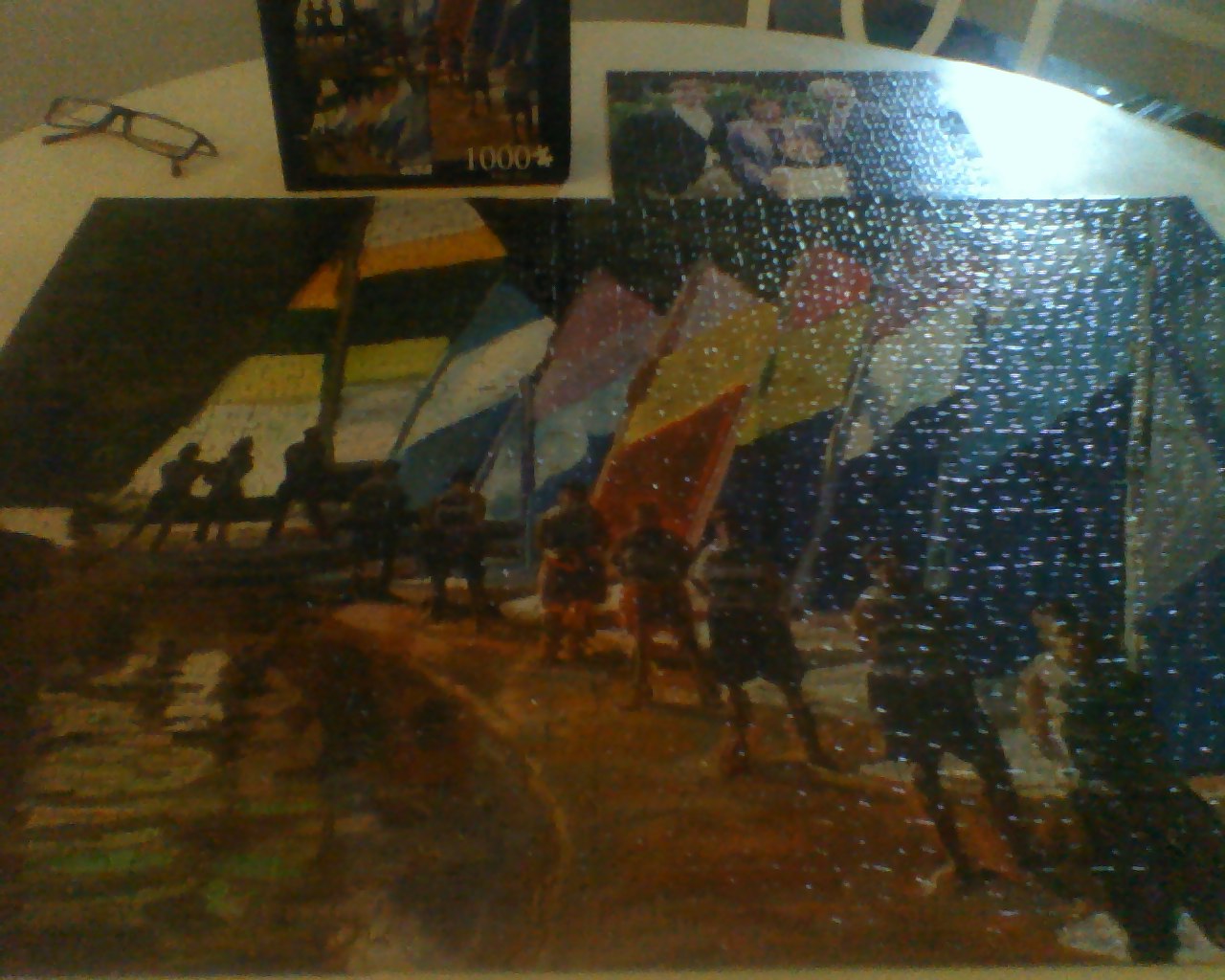
We stormed through this 1000-piece puzzle, starting it Friday evening and finishing it Saturday afternoon.  We piddled around after we finished, enjoying the afternoon listening to football and topped off the day with a nice mom-cooked meal.  By 8:40 we were in the car, making a beat-the-clock run to Barnes and Noble for another puzzle (why did this feel like those runs to the liquor store that sat inches beyond the county line of the "dry" Texas county I grew up in?).

Philip the Handsome is not languishing.  More like biding his time, until he is once again cleared for action.  The light's not great in the hall, but I think this shot gives you an idea about his mindset.


Monday, September 10, 2012

Rise and Shine

September 10, 2012

Sometimes Mondays don't seem that bad.


This is what Willie, Teddy, and I witnessed as we rounded the bend through the picnic area and climbed to the top of the dam this morning.  I knew there was an up side to getting a bit of a late start this morning (you know, in addition to that extra half and hour in the sack).

Walter is headed towards the airport to start his journey home from Ohio.  Philip the Handsome is going to have to make it on his own for a couple of days (though I think Walter is laid in a reasonable stock of provisions to make sure he doesn't starve or run out of toilet paper).

Thursday, September 6, 2012

Rest and Recover

September 6, 2012

Philip the Handsome [There.  I have picked the cool name.  There were two "big" Maximillians:  one from the Holy Roman Empire, who had a son named Philip the Handsome and one from the Mexican Empire who had two sons, Augustin and Salvador.  As much as I would have like to pick Augustin (which is a variant of what I would have been named had I been born a boy) or Salvador (which has such lovely Godfather overtones), I stuck with Philip the Handsome.  Because really, Walter is so much more of a Holy Roman Emperor than a Mexican Emperor, and Davis really deserves a name that ends in "the Handsome."] is safely home from surgery.

Like any surgery, it was probably a bigger deal than we counted on before it started.  And like any surgery, the recovery and rehabilitation is probably a much bigger deal than the surgery itself.  You can email him your warm wishes at c.davis.buenger@gmail.com or text him at 979.820.1049.  I think he has to be zero weight bearing for four weeks.

Walter took some photos with his phone.  Here's the lovely leg wear all the cool guys are sporting this fall:


Here's Davis trying to look comfortable and busy. 


Can you tell from the first two photos what the mainstay of his recovery is, so far?   Legos!


Wednesday, September 5, 2012

Unstinting (excuse my adjective instead of a verb)

September 5, 2012

The NY Giants kick off against the Dallas Cowboys tonight, their coach Tom Coughlin could wear a gold ribbon on his chest.


In case you missed it, the small, but mighty childhood cancer community is unstinting in its determination to get the nation's attention and focus it on children and teens with cancer.  More walks, more lemonade, more cookies, more kickball, more shaved heads, more garage sales, more beaded lanyards.

That doesn't obligate me to write about childhood cancer, but with Davis heading to surgery in the morning, my mind is on him, and on Erin tonight.


This blurry (artsy?) photo is my phone screensaver.  I look at it every day.  Raising strong-willed, bright kids nine years apart in age was never going to be a picnic, and having one with cancer added a degree of difficulty that I hadn't anticipated.

I have often heard or read notes from moms and dads whose child died about how respond to when someone asks them how many children they have.  Most people work out their own personal answer.  What I hadn't reckoned on was what Davis encounters on a parallel, but completely different track.

As a single guy he has had his share of first dates.  You remember those?  The jitters.  What to wear?  Where to go?  What to talk about?  What NOT to talk about?

Anybody who reads magazine pieces or blog entries about "safe" first date conversational topics, places to go, or other ways to quell the nerves, will recognize that asking your new acquaintance about their major is sort of de rigeur.  That is, unless your major is theoretical mathematics.  That's a certain conversation stopper which leaves the new acquaintance searching for safer, more settled territory, like "Do you have any brother or sisters?"  Asking about siblings is considered VERY SAFE.

Except when your sister who you loved very much died of cancer.  No matter how you answer, it's likely to de-rail the date.  You either tell the truth and wait for the awkward silence to quit roaring in your ears or you dodge the question and feel like you've betrayed your sister's memory.  Even if you explain the circumstances and the new acquaintance responds sympathetically, it changes the dynamics and the trajectory of the first date, which is already a very risk-filled proposition.

So my wish today in memory of Erin and in honor of childhood cancer awareness month is saving all the children so that their brothers and sisters don't have to figure out what it means to live without them.

Sunday, September 2, 2012

Muse

September 2, 2012

I took stock of my life the other day.  With a birthday coming along in a few weeks and a long summer behind me, I thought it worth the effort.  As I looked around, I noticed my yard had gone feral.  My house provides natural habitats for a majority of the spiders found in Texas, if the number and variety of cobwebs inside my house provides any evidence.  I've added a couple of pounds since graduation.  I'm teaching two sections of a course I haven't taught since the semester Davis was born, and I have an iron or two (or a dozen) in the fire of what Walter calls my unpaid work.

I took the mulling time offered by my morning dog walk to consider what to do with my life going forward.  I had three big thoughts:


  1. Work harder to separate work from leisure.  For me that means, focusing and not getting distracted when I'm working (pretty easy) AND turning work off at the end of the day and focusing just as hard and just as intentionally on downtime.
  2. Work on simplifying and adopting routines that I can sustain.  This means, for example, that I attempt to up my trips to the gym from twice a week to thrice a week NOT to promise myself I'll workout every day.
  3. Work on a balanced life.  I started doing the math here.  
    • First and most importantly, 8 (or even 9) hours of sleep each night.
    • Then no more than 8 hours of work (except if I have a grading deadline) each day.
    • Followed by 8 hours of health-and-home maintenance and upkeep (weeding, dusting, organizing, cooking healthy, and so on) each day.
    • Topped off by 8 hours of personal leisure and self and relationship enhancement.
I'm not sure what I was thinking with #3, but by the time I got home I was really happy and confident about how easy it was going to be to get everything important done and maintain a balanced life.  I was also wondering, just a little, what I had been doing to waste so much time these last thirty years (and by the way, I know what I was doing to waste time the first 21). 

Anyway, a woman doesn't give birth to a PhD student in mathematics without having some facility with numbers, so as you have already guessed, I figured out that I had either made an arithmetic error or a scientific one (imagining that I lived on planet Umbrathos, that has a 32 hour day).  This discovery led me to two more important thoughts.  I should:

  1. Get my friends and family to buy me longer days for my upcoming birthday.  I wonder if you can get gift cards with extra hours? or
  2. I should have grabbed the magic wish fish when I had the chance.  As Walter rowed up to dock the boat yesterday, a bass as big as Teddy hopped right in the rowboat and flopped fin-slappingly around.  Walter, always the poised boatsman, shipped his oars, stood up (I know, you're thinking "Danger, Danger, Will Robinson!", grabbed the fish in both hands, and tossed it back in the lake.  If I had only had the presence of mind to have him ask for his three wishes before the rescue. . .

Sunday, August 26, 2012

Ticket

August 26, 2012

School starts tomorrow, and I feel like a bride--Something Old (my usual graduate project management course), Something New (new students, new semester, new school year), and Something Really, Really Old:  a course that I haven't taught since the spring that Davis was born.

As usual, I took a day the week before the start of classes to hang out at Davis and Erin's elementary school, Mary Branch, and have a lanyard extravaganza.  Not that many teachers from Davis's years there remain, though his kindergarten teacher and his 5th grade teacher are still in the teaching yoke and remember him fondly.

Even a number of those who taught Erin have moved on.  Still, her presence and influence still pervades the campus.  Several of the teachers brought new grade-level colleagues down to our display to initiate them into the school year and the appropriate ID-wear.

One of the long-time first grade teachers kept returning to the library to run up her tab, and during one of her stops she told me a story about Erin I had never heard.

Apparently, Erin started the student council at Mary Branch.  Maybe I knew that at the time, but forgot.  Anyway, one of their first initiatives (that is still going on, I think) was her pet project to turn the campus green (not with paint, but with environmental friendliness and energy conservation).  As Ms. Hodnett told the story, certain student council members, including Erin, formed an official energy conservation patrol.  They carried ticket books and could write up and issue tickets to anyone, including adults, who were wasting energy (by leaving lights on or water running or otherwise participating in wasteful activities).  Besides whatever actual consequence receiving a ticket had (a fine, perhaps?), there was also the good-natured teasing that came from purer colleagues who had not yet been caught.

Ms. Hodnett had left her room one afternoon to check her mail or stop in the restroom or some such thing.  She left a pair of maintenance workers doing some sort of minor repair to her classroom.  When she returned, the workers were gone, the lights were still burning, and Erin had strolled up with her ticket book and begun filling out an energy citation.


Ms. Hodnett pleaded with her not to give her a ticket.  Erin looked at her skeptically, just like an old-hand cop waiting to hear some manufactured excuse or a teacher listening as a student explained how her dog ate her homework.  Finally, Ms. Hodnett said that it just wasn't fair for her to get the ticket when the workmen had left the lights on.  Erin responded, "Okay, Ms. Hodnett.  Just this once, I'll let you off with a warning, but next time it will mean big trouble."

She really doesn't look that wicked, do you think?


Erin's classmates start tenth grade tomorrow.  I wish them the best school year ever and peace for their parents as they become licensed drivers this year.   And, of course, that they receive warnings instead of tickets, if they ever get stopped.

I've been wondering:  if I leave my lights on and the faucet running, maybe she'll show up and write me a ticket.

Tuesday, August 21, 2012

Follow Up

August 21, 2012

Within an hour or so of posting about Davis's knee surgery yesterday, my cell phone made its little you-have-a-text noise.  A quick glance revealed the following:


"Where is my cool name?"

Polls open for the Maximillian equivalent for Davis's post-surgery blog exploits.  I'm thinking if he wants "cool," I may have to stick with Cucumber or maybe Cuke for short.  Ice Pack?  Other options?

Monday, August 20, 2012

Hobble

August 20, 2012

Here's your quiz:

  1. Q:  Name Sissy Spacek's cousin, who served in the Corps of Cadets at Texas A&M and also played "Artie" on the Larry Sanders show:  Elmore Rual "Rip" A:________________________ 
  2. Q:  What rhymes with hibiscus and also throw the discuss?  A:________________________
  3. Q:  Where can you have the most fun riding dirt bikes and ATV's in the state?  A:_______________
  4. Q:  Where's the best place in Austin to listen to live music?  A:  ________________________


If you answered:

  1. Torn
  2. Meniscus
  3. T.O.R.N.*
  4. A.C.L.**
you would have the answer to why this post is titled "Hobble."  Davis injured his knee playing soccer about ten days ago.  He saw a doctor, then had an MRI last week.  Results?   He will see a surgeon Wednesday morning, and Walter and I will each make an unplanned trip to Columbus to engage in some postoperative bedside nursing sooner rather than later.

If you want to send him a note, he is on Facebook and his email is c.davis.buenger@gmail.com


*Texas Off-Road Nationals
**Austin City Limits


Monday, August 13, 2012

Return

August 13, 2012

I eased back into the office today.  My desk chair remembered me and everything else seemed just like I had left it on May 8. Nobody had filed the stacks of papers I left on my desk and credenza on May 8th.  Do the little elves who helped the shoemaker at night do the work he left behind need an engraved invitation?  What about the brownies?  I know they are shy and light sensitive, but I left the lights off for three months.  You think they would have taken a peak inside and seen I was a little desperate.

Instead, I am left to shovel the mounds myself.  And tomorrow I'm going to have to force myself to look in the coffee cup and see what miracle may be growing there.  

For now, thought, I'm going to go home.  Maximillian has about another week in his boot.  That means I have just seven days left to convince him to add some chains, studs, and buckles to it so he can have the ultra in steam-punk footwear.  

Before:


My envisioned After:


The long summer of our discontent doldrums will end soon.  He set aside the crutches on our vacation, started driving a week ago, and I think, has a research trip to Austin planned for next week.  Soon, I will throw away his nickname and let the memory of this summer fade into our history together.  

We'll be ready for the next chapter.  Now, if I can just face up to coming back to my mess of an office again tomorrow, I can actually get moving on that new chapter.


Thursday, August 9, 2012

Dive

August 9, 2012

Thanks for the advice and information about mattresses.  No, I haven't followed up yet.  Yes, I will bubble it up to the top, hopefully soon.  That means I'm still open to suggestions if you have them.

My planned entry today was called "Doors of Taos."  I had planned an artistic and quirky exploration of the photos I took on vacation last year (that I recently re-discovered), showing how much more imagination some people have about their front portals than I do.

If my Mac App store sends me my password, meaning I can log on and download a free collage-maker photo app, and if I can figure out how to use it, that entry might yet be forthcoming.

However, since that little chore is shaping up like so many other small, but cranky tasks on my to-do list (that is, to do something that will take four minutes requires 114 minutes of something else--updating software, sitting on hold, waiting in line, or balancing on one foot swinging a paper bag around my head, and screaming like a chicken), I will have to slope towards a different, less artsy, but still quirky topic.

"Death to the Tyrants.  Death to the Frogs."

Yes, this this Willie's new theme song.  For years, my mom and I have worried about the Leisure Lake frog and toad population.  What was once an expanding and robust part of the local ecosystem--thanks to a Master Naturalist recording, we could identify multiple varieties on our walk around the lake, including, of course bullfrogs who would boom warnings of impending rain and cricket frogs who would imitate insect voices as we walked by--started dwindling a few years ago.  We even stopped seeing flat frog victims in the road, a definite sign of either smarter or fewer frogs in the area.

This spring and summer have reversed that trend.  Twenty-one inches of rain by the end of March plus an unexpected four and a half inches in July have swelled the froggy numbers.  Willie, intrepid hunter that he is, has discovered the passion of frog stalking and trapping.  It certainly helps that I never made it to the flower beds to weed this summer--re-creating the grassy high-veld of his forefathers in southern Zambabwe (Rhodesia).

He traps the frogs under his hammerlike paw than carries them around in his mouth until they wiggle away.  I'm not sure what benefits accrue. . . perhaps frog pee refreshes?  Anyway, this morning, as I was launching Maximillian in his row boat, Willie was directing the equivalent of the Fort Stockton Water Carnival on the shore.  Each frog dived into the lake in sequence, synchronized just like the opening act of an Esther Williams movie or maybe more like this:


Saturday, August 4, 2012

Mattress Bleg

August 4, 2012


Did I really need to go on vacation to have time to post to "Let's Do It"?  Apparently, yes.


Let's just say that life has been galloping by.  Every day for the last two weeks I have glimpsed bloggable ideas, sometimes as I walk Willie and Teddy, sometimes as I ferry Maximillian around town, sometimes when I'm two-thirds of the way through a scintillating conference call.  I just haven't had time to rif on any of them.


Maybe I'll catch up this week.  Maybe not.


I want to start with a simple, straight forward plea for crowd sourcing (and the hat tip in this case goes to my buddy Janice S. who actually did this on FB earlier this week).


First off, an explanation for bleg (blog + beg).  I don't remember where I first saw this.  I think maybe I read it on Paul Krugman's site a couple of years ago, but Tyler Cowen on the Marginal Revolution blog, blegs when he travels to learn where he should eat (or not eat).  I have been wanting to consult my friends in the same way.  .  . and Janice offered up the perfect bleg topic.


Mattresses.  


In 1990, Walter and I moved to Nashville, and since the generous Owen School of Management was picking up the check, we moved everything we owned (which is another story about how our furniture detoured through Graceland for several days because our mover was also an Elvis impersonator and our move coincided with Elvis Week--coming this year in just five days).  The next year, when Walter returned to A&M, our mattress stayed with me, and he went to Sears and bought one for our Bryan house (Can you read the subtext here that I was not involved in the purchase process, which didn't matter a huge amount, since sleeping is one of my best things).


Somehow, when we moved completely back to Bryan a few years later, we gave our pretty good mattress with a pillow top, to our neighbors rather than switching the firm and adequate mattress out and giving it away.  


Twenty-one years later we are getting around to thinking about starting the process of considering whether we are up to the challenge of buying a new mattress.  Really.  It's about time.  Except the process is so confounding and confusing, not to mention expensive--firm, soft, pillow top, memory foam, air chambers, too many brands, hard to compare.  Ach!


I've slept on three different mattresses over the last three nights.  They are all better than my ancient Sears no-frills mattress, but are any of them the one I want to spend the next twenty years sleeping on?  How can I even tell?  Even if I found THE ONE, these brands/models aren't available in stores because they are made specifically for the different hotel chains.


It's enough to make me say naughty words.


Here comes the bleg (and note that it comes with a "please" and whipped cream and a cherry on top):


Tell me about your mattress:  

  • what do you like about it?
  • what did you consider as important in deciding when you bought it?
  • do you feel strongly enough to recommend for or against? 
Please help me.  I'm so confused.


Tuesday, July 17, 2012

Manpurse

July 17, 2012


Davis found a new answer to the question "What's in Your Wallet?" yet somehow the answer gives rise to other questions, like "Why is your wallet so large?" and "Would that pass through airport security?" and "How can you ever find shoes to match?"


Wednesday, July 11, 2012

Mess/Clean (in that order)

July 10, 2012


Prepare to be wowed!


We often depend heavily on Davis when he comes for a visit.  Not that we're enfeebled or anything like that, but I think there is an American (perhaps worldwide) tradition of celebrating an anticipated homecoming of a grown child by having some (not too many) undone chores waiting.  (NOTE BENE:  if this tradition doesn't exist, it should).


Davis has always cheerfully complied--changing hard-to-reach light bulbs, planting waiting shrubs, and on several occasions washing and staining the deck and porch.  We (in this case, Davis and I) have been working on a plan for him to pave the backyard slab with festive brickwork, but with just a week in town, we didn't get to that this time.


Instead we tackled the shed--built in 1994.  And since the move-in that summer, many things have gone in but few have come back out.  Did I mention this is Walter's shed?  Did I mention that despite much lobbying for at least a decade, it has never been cleaned or even really tidied up since the day we moved in?  Here's a visual tour (I'm thinking these photos could be the basis for The Ultimate I Spy Hidden Object book:  20-pack of Coors Light, manual sheep shears, hummingbird feeder, kayak caddy):


Of course, the first step was to pull everything out.  We grouped like with like as we worked and hoped that Walter would wheel out at some point and give us at least tacit permission to throw some things away.  You can see in the upper left corner of the first photo below that we set up a comfy seat for him to make his pronouncements from (it remained empty, save to hold the laptop so we could listen to pandora while we worked).


After we got it all out and did some heavy-duty cleaning (and, unfortunately, spilling almost a quart of oil that a random rodent had gnawed a hole in.  NOTE BENE:  there are many great sources and an equal number of not-so-great sources of information on the internet about what to do when you spill a quart of oil on your shop floor), we were none too certain it would go back in and look any different than it had before.  

As you probably know (through observation of others, not through your own personal experience), once an organizing system gets out of control, it's easier to buy a "new thing" that you need rather than spend time looking for the one you already own that's "in there some place."  Plus you run out of time, so when you finish the project you toss the "new thing" in the shed with a promise to put it away in the "right" place when you have the time.  That is how you might end up with multiple versions of the same needle-nosed pliers, paint accoutrements, or sprinkler parts.


This is especially true on items like nuts and bolts and other kinds of fasteners, which were strewn about in yogurt cups, Texmati rice containers, pill bottles, and every flat surface in the shed.  Davis and his friend Sam took the time to do fine-grain sorting and build a maintainable system to store and later locate these items:


This was not quick work.  But it yielded good results.  You can't really tell, but the nuts in the drawers on the top row are sorted (and labeled) by size in each drawer and by types in sections within each drawer that Davis fabricated out of corrugated plastic, AND they match to the bolts in the drawer directly underneath which are also sort by size, type, and length.


And in case you are wondering, we freecycled, recycled, and shared quite a lot that we took out of the shed (with Walter's blessing, no less).  I think Davis and I were hoping to thin things out by 5-10%, and we may have hit 15-18%.


We (Davis and I) thought the things on the table were throw-away-able, but this is the stack that Walter is going to work on and fix.  And if that doesn't materialize, at least we will have a pictorial record and know for sure when we have reached the bottom layer next time we have to excavate the shed.

Saturday, July 7, 2012

Swim

July 7, 2012

Maximillian got clearance to head back to the pool this week.  We didn't actually have the opportunity to practice the approach logistics repeatedly and to perfection like we did with rowing, but we had a theoretically sound plan and we did cover the details to the nth degree.  This included two separate store runs to find the appropriate swim sock.  Who knew you had to choose the correct psi (Pounds per Square Inch) when buying compression socks?  Probably everyone but me.


Everything worked out, and his sock did not absorb enough water to sink him.   Here is proof--the last five seconds of a fifty-five minute swim:


He swam for 55 minutes on Monday, Wednesday, and Friday, bringing a much needed change of pace to his daily exercise routine.  Really, how many times would you get excited about rowing the circumference of a rapidly shrinking 25 acre lake?  At one lap every twenty-five minutes, three laps per day, seven days per week, I would imagine the scenery would run out of oomph and visual delights fairly quickly.


Even better than the change of scenery was the triumphal return to the TAMU Rec Center.   


There may not have been antiphonal trumpets, but after eight weeks mothballed at home, Maximillian was happy to get back.  You could tell all his buddies had missed him.  They may not be a talkative bunch and they may barely know each others' names, but they've had neighboring lockers, shared swim lanes, and spotted each other in the weight room for thirty plus years.


By the end of the week, Maximillian began experimenting with partial weight bearing.  He weighed his foot and figured out what about 40 pounds of pressure felt like (stepping on it, not wearing it as a sock).  Now he is working his way up to supporting that much as he walks along.